Evaluating the Impact of Bruxism on Dental Work: Crowns, Bridges, and Implants
Explore how bruxism affects crowns, bridges, and implants, and learn precautionary measures.
If you grind your teeth at night, you're in good company. Up to one in five adults shows signs of bruxism, the clenching and grinding habit that loves to wreak havoc while you sleep. Dentists see the evidence every day: flattened cusps, chipped fillings, and prosthetic work that fails long before its time. You're here to learn about the bruxism dental work impact on crowns, bridges, and implants, and how to stop the damage. Let's dive into the research and keep the jargon to a minimum.
As you read, you'll find links to peer-reviewed studies and reputable medical sites. Click them if you want to dive deeper. Otherwise, keep reading for a straightforward exploration of what the science says about bruxism and your dental work.
Understanding Bruxism and Its Dental Implications
Defining Bruxism
Bruxism is repetitive jaw-muscle activity that results in clenching or grinding of the teeth, often during sleep. Most people don't realize they do it until a partner hears the noise or a dentist notices the wear marks. Sleep bruxism is considered a movement disorder and differs from normal chewing done when eating.
Risk Factors and Early Warning Signs
Some people are more prone to grinding. High-stress professions like ER nurses or air-traffic controllers top the list. Genetics, obstructive sleep apnea, and certain antidepressant medications can also trigger it. Warning signs include scalloped tongue edges, morning jaw fatigue, and shiny marks where teeth slide against each other. If you notice these signs or your partner hears a garbage disposal sound at night, it's time to talk prevention with your dentist. For more on stress-related jaw pain, you might find how stress contributes to jaw pain insightful.
Mechanics of Damage
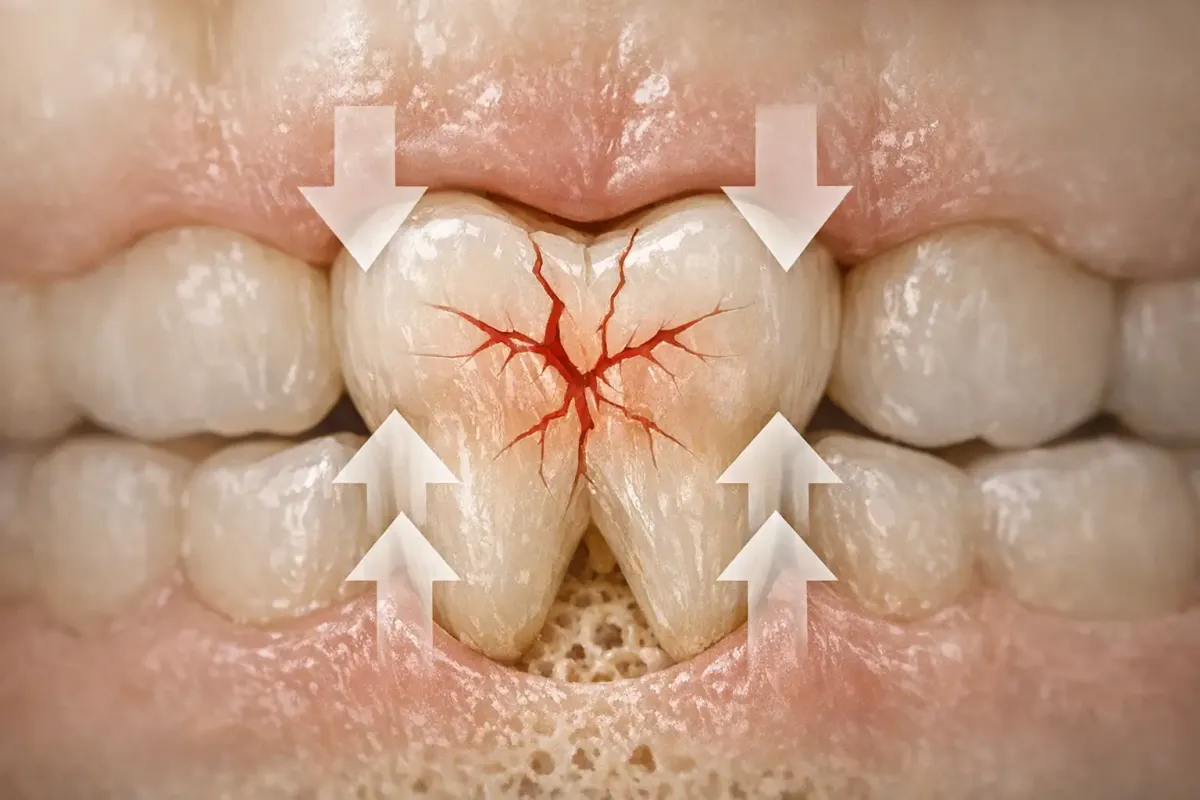
During nocturnal grinding, bite forces can exceed 250 pounds per square inch. Natural enamel is tough, but porcelain and composite resins are more brittle. Micro-fractures develop, margins open, and cements loosen. Over time, you might notice:
- Shortened or flattened teeth
- Chipped edges on crowns or veneers
- Sensitivity to cold due to enamel loss
- Loose bridges or cracked implant abutments
Imagine a car idling at 5,000 RPM all night; the engine won't last. Teeth and restorations behave the same way. One patient in our clinic had a brand-new porcelain veneer last less than nine months; microscopic cracks silently grew until a corn chip finished the job at lunch. Night after night, even the most sophisticated ceramic behaves like fine china dropped on tile. Understanding the long-term effects of bruxism on dental health can provide deeper insight into this issue.
What the Studies Say
The Cleveland Clinic notes that bruxism can double the failure rate of certain restorations. Meanwhile, a biomechanical analysis in American Dental Association guidelines shows that cyclic loading from grinding shortens the lifespan of most dental materials. If you're interested in innovative treatments, explore advanced bruxism treatments for the latest clinical innovations.
The Effect of Bruxism on Dental Crowns
Crowns are caps that cover the visible part of a tooth, restoring shape and strength. With bruxism, they catch the brunt of the action.
Types of Crowns Affected
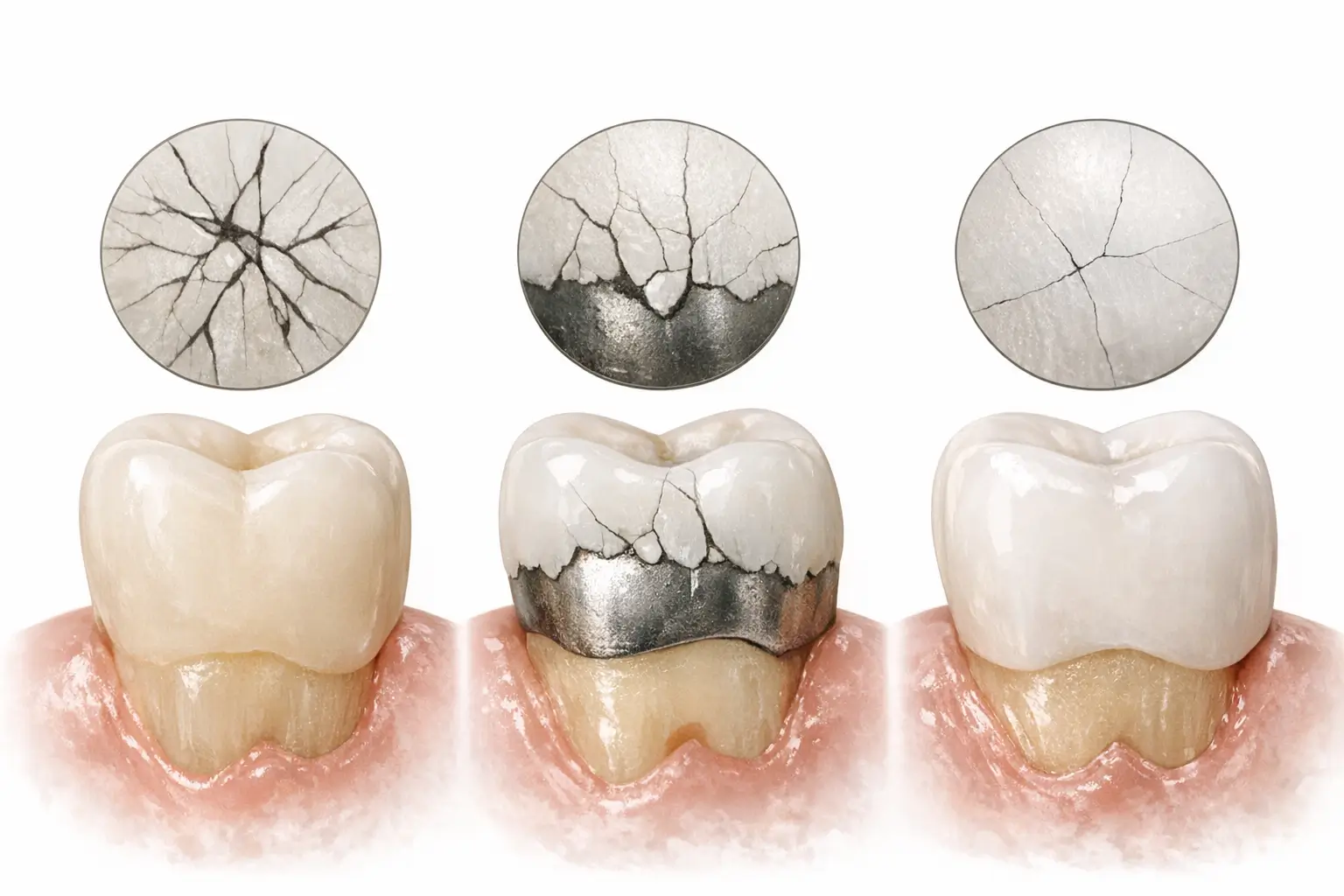
You may have ceramic, porcelain-fused-to-metal (PFM), or zirconia crowns. Each material responds differently to grinding:
- Ceramic: A 2026 randomized controlled trial by Bömicke et al. tracked 120 ceramic crowns in bruxers and non-bruxers for three years. Survival in bruxers was 88 percent compared with 97 percent in controls. The main issue was chipping of the veneering layer.
- PFM: The metal substructure adds strength, but porcelain on top can still fracture under high loads. Chrcanovic and colleagues linked higher bite force to more frequent porcelain cracks in their 2025 bite-force study (study 7).
- Zirconia: Zirconia is the tank of dental ceramics. Still, edge chipping has been reported, especially in thin-margined designs.
For more on whether you might need a new night guard after getting a crown, check out our detailed exploration.
Technical Complications and Survival
The main concerns for crowns in bruxers are fracture and loss of retention. According to the bite-force study, bruxers showed a threefold increase in crown fractures compared with non-bruxers over four years. Cement failure occurred twice as often. Repair is costly, and each redo removes more tooth structure, worsening the long-term outlook.
Crown anatomy matters. Flat occlusal surfaces distribute forces better than steep cusps. Dentists now design crowns with broader contacts and use high-strength cements to compensate, but even these tweaks can't fully offset nightly grinding. Prevention is key, which we'll discuss later. If your dentist suggests a modest bite adjustment or adds a "faux wear facet" to redirect force, pay attention, those millimeters can save you hundreds of dollars down the road.
Bruxism's Impact on Dental Bridges
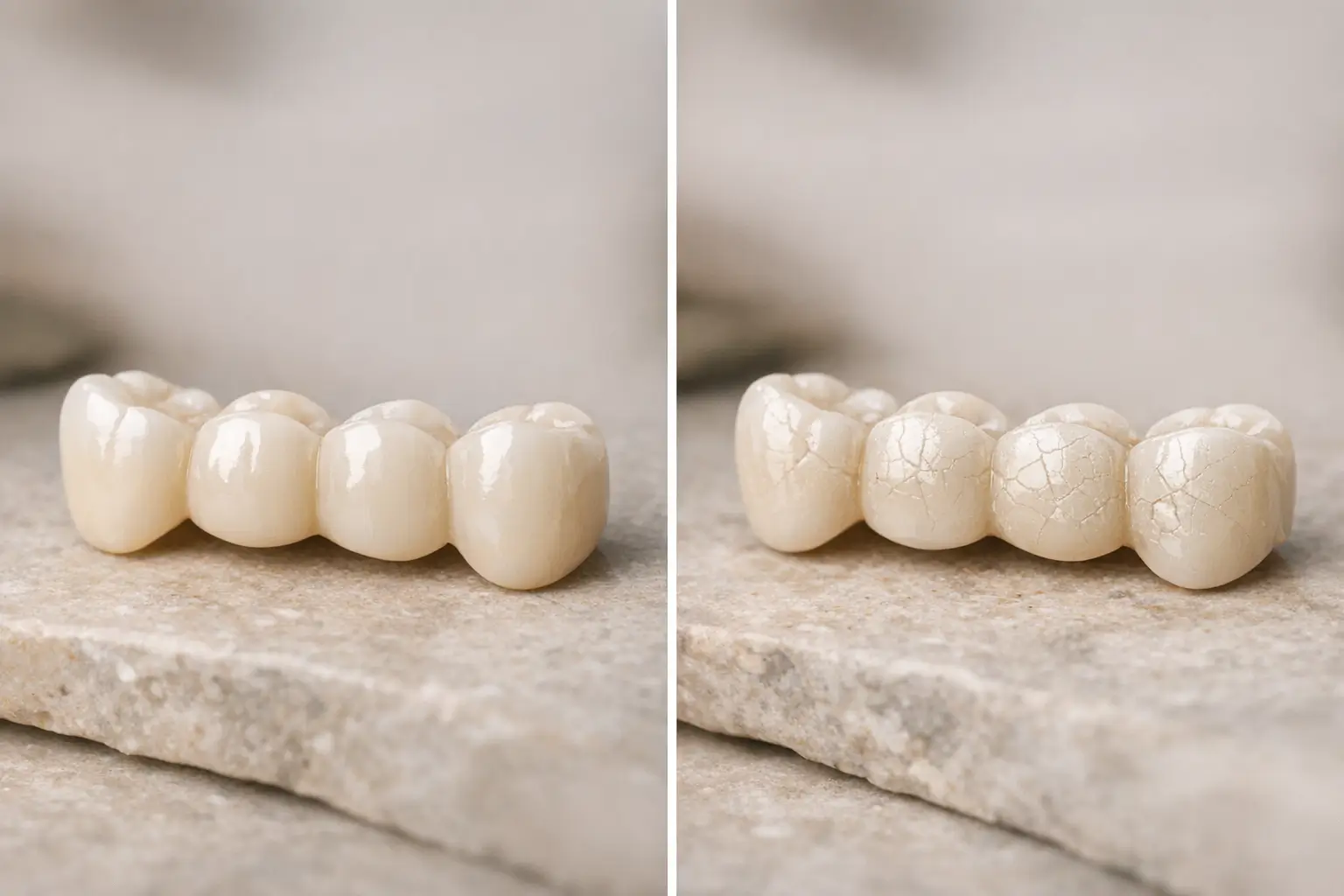
Bridges replace missing teeth by anchoring to neighboring abutment teeth. They span gaps like mini cantilevers, and constant grinding makes them flex more than the design permits. If you're wondering whether you can wear a night guard with a dental bridge, we have detailed information available.
Material Considerations
The scoping review by Al-Talib et al. examined over 20 studies on restoration failure in bruxers. Metal and ceramic bridges outlasted all-ceramic ones, but even metal frameworks exhibited solder joint fractures in heavy grinders.
For resin-bonded "Maryland" bridges, the adhesive interface is the weak link. Bruxism elevates shear forces at the wings, popping them loose. Chrcanovic’s bite-force data [7] found that debonding was four times more frequent in self-reported bruxers.
Long-term Outcomes
Bridge survival studies rarely exceed ten years, but trends are clear. A mixed-materials bridge in a bruxer loses roughly one year of expected service life for every five years of functioning, according to pooled estimates in the scoping review. Cracks in veneering porcelain start first, followed by marginal leakage around retainers. If the abutment teeth themselves chip or fracture, the entire prosthesis may fail. Replacing a bridge often means crowns on additional teeth, so the snowball effect is real.
Real-world example: one patient with a three-unit PFM bridge chewed through the porcelain on the pontic within two years. The lab replacement cost more than the original build because underlying metal also warped. Adding a night guard after the redo has kept the remake pristine for four years and counting.
Bottom line: if you grind, expect more maintenance visits and factor that into the cost calculus when choosing between bridge and implant.
Dental Implants and Bruxism: A Risky Combination?
Implants are touted as the gold standard for tooth replacement. They integrate with bone and don't decay. But does bruxism threaten their super-hero reputation? Let's check the data. For more detailed risks and management strategies, see our article on dental implants and bruxism.
Implant Survival and Marginal Bone Loss
A 2024 systematic review and meta-analysis by Häggman-Henrikson et al. pooled results from 16 trials involving over 1,200 bruxer implants. The headline: implant survival was still high at 94 percent over five years, but bruxers had nearly double the risk of early failure compared with non-bruxers.
The culprit was not the titanium screw snapping in half. Instead, marginal bone around the implant neck suffered micro-damage, leading to crestal bone loss greater than 1.5 mm in the first year. Excessive lateral forces from grinding drive micro-motions at the bone and implant interface, triggering inflammation and resorption.
Another danger zone is the implant crown or abutment. Ceramic crowns on implants chipped more often in bruxers, paralleling the problem seen in tooth-borne crowns. Some clinicians switch to monolithic zirconia or even hybrid resin crowns to absorb shock, though evidence for superiority remains limited. In addition, screw loosening is a silent menace, with torque loss occurring in 22% of bruxing patients within the first year. Scheduled retightening appointments (think of them as "oil changes" for your implants) cut that incidence in half.
Precautionary Measures
Dentists adopt a layered defense:
- Night guards: A hard acrylic occlusal splint distributes chewing forces more evenly across your arch, sparing the implant peak loads. Learn more about the benefits of custom mouth guards for teeth grinding.
- Occlusal adjustment: Fine-tuning the bite reduces high contact points that act as fulcrums.
- Platform-switch abutments: Shifting the implant and abutment junction inward may cut bone loss, though evidence is still maturing.
- Short cantilevers: Avoiding long distal extensions means less leverage on the implant during grinding events.
If you already have implants and suspect bruxism, don't panic. Regular monitoring with periapical radiographs helps catch early bone changes, and adjustments can be made long before catastrophic failure.
Precautionary Measures for Bruxism Patients
You can't change the fact that you grind, at least not overnight. You can, however, blunt the damage. Let's look at two pillars of protection: occlusal splints and stress management.
Occlusal Splints
The gold standard is the hard acrylic full-coverage night guard, also called a Michigan splint. In a cone-beam CT and MRI-based study, Vaniya et al. measured joint space before and after six weeks of splint use. Median joint space increased by 0.3 mm, suggesting decompression of the temporomandibular joint, and patients reported fewer morning headaches.
A second trial compared splints with behavioral therapy. The 2025 randomized clinical study by Tandon et al. showed that splints reduced wear facets by 46 percent over three months, while sleep hygiene plus progressive muscle relaxation achieved a 29 percent reduction. Combine both and you get the best of each world. If you struggle with tolerating a night guard, explore effective alternatives.
Custom lab-made guards trump off-the-shelf "boil-and-bite" versions in durability and fit. They also tend to stay put, meaning less drool-induced pillow flipping at 2 a.m. Clean your guard daily with a non-abrasive cleanser, store it dry, and bring it to check-ups so the dentist can inspect for micro-cracks. Most last three to five years if you avoid hot water and curious dogs.
Stress Management Techniques
Grinding often spikes during life's pressure-cooker moments. Simple interventions matter:
- Regular exercise to burn off cortisol
- Mindfulness meditation before bed
- Limiting caffeine and alcohol in the evening
- Keeping a consistent sleep schedule
These may sound like generic wellness tips, but remember that bruxism has a neurologic component tied to arousals during sleep. Anything that calms your nervous system lowers grinding frequency. The Mayo Clinic notes that lifestyle fixes can be as impactful as mechanical appliances, especially for mild to moderate cases. If stress feels unmanageable, a brief course of cognitive-behavioral therapy (CBT) can teach coping skills and has been shown to cut sleep bruxism episodes by up to 30% in pilot studies. For more about the role of CBT, see how CBT alleviates bruxism symptoms.
Innovative Approaches to Dental Restoration
3D-Printed Solutions
Chairside 3D printing lets dentists fabricate splints and provisional crowns in a single visit. In a case report, Monteiro et al. used printed nanohybrid resin to restore a patient with severe erosion and bruxism. The resin acted as a sacrificial layer: it absorbed shock and was easily replaced after six months, while underlying structures stayed intact. Not a magic bullet, but a cost-effective buffer.
Non-Invasive Techniques
For gap replacement, no-prep zirconia cantilever resin-bonded prostheses are gaining fanfare. They require minimal drilling, sparing enamel. Mainjot’s 2025 report followed 22 such cantilevers in bruxers for two years. Only one debonded, and repair took ten minutes with a new adhesive kit. The key is using high-strength zirconia wings kept out of heavy occlusal contact.
Other cool frontiers include flexible fiber-reinforced composites and shock-absorbing implant abutments made from peek polymer. Early data are promising, but long-term studies are still developing.
Conclusion
Your take-home is straightforward. Bruxism doesn't guarantee the downfall of crowns, bridges, or implants, but it adds extra risk. Ceramic crowns chip, bridges debond, and implants lose bone faster when subjected to relentless night-time forces. Evidence from randomized trials, systematic reviews, and imaging studies paints a clear picture: proactive management is cheaper and easier than repair.
If you suspect you are a grinder, talk to your dentist about a custom occlusal splint, review your stress profile, and consider materials engineered to take a punch. Modern dentistry offers 3D-printed resins, zirconia cantilevers, and shock-dampening abutments that were science fiction a decade ago. Use them wisely, keep your recall visits, and your dental work can live a long, uneventful life despite the nightly rumble.