Can You Wear a Night Guard With a Dental Bridge?
Yes, and if you grind, your dentist will probably want you to. The catch is fit: a guard made before the bridge went in won't match the new crowns and false tooth. Here is when to wear one, how to tell if yours still fits, and how to keep the bridge clean underneath.
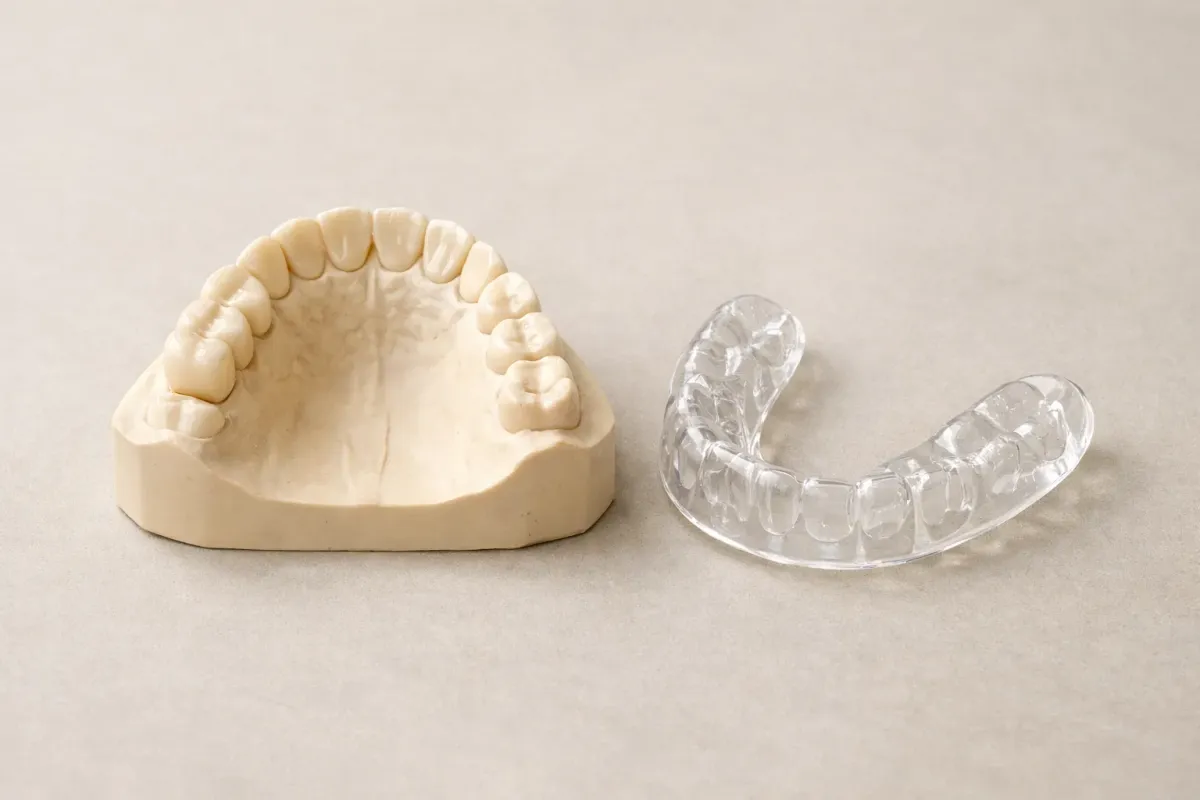
Yes, you can wear a night guard with a dental bridge, and if you grind your teeth your dentist will probably want you to. The catch is fit: a guard made before the bridge went in was shaped around teeth that no longer look the same, so you will usually need an adjustment or a new guard made from a fresh impression.
Why a bridge makes the guard more important, not less
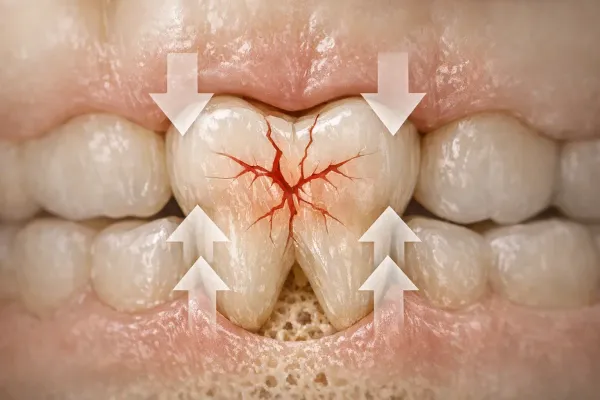
A bridge replaces a missing tooth by hanging a false tooth (the pontic) between crowns cemented onto the teeth on either side (the abutments). Every time you bite, the force on that false tooth gets passed to the abutments. At night, a grinder adds sideways force for minutes at a time, and the bridge has no way to shrug it off.
The research backs up the worry. A 2025 scoping review in the Journal of Dentistry pulled together 46 studies on bruxism and restoration failure and concluded that bruxism is a risk factor for failure of both direct and indirect restorations, a group that includes crowns and fixed partial dentures (the formal name for a bridge). The one material it flagged as the exception was monolithic zirconia. The authors also noted that most of the studies were retrospective, so the evidence is consistent rather than airtight.
A small 2026 prospective study in the Journal of Esthetic and Restorative Dentistry followed 40 people with 3D-printed resin bridges for about 28 months. Wear showed up in 40% of the grinders' bridges versus 10% in the non-grinders, and the only fracture happened in the grinding group.
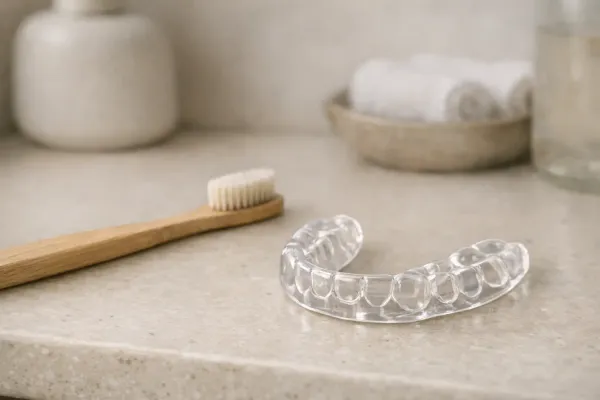
A night guard does not stop you grinding. It puts a replaceable layer of plastic between your upper and lower teeth so the plastic takes the wear instead of your porcelain.
When you can start wearing a guard again
There is no healing wound with a standard bridge, so the timeline depends on the bridge and the guard, not your gums.
- During the temporary bridge phase (usually a couple of weeks): temporaries are held on with weak cement on purpose, so they come off easily at the next visit. A tight guard can pull one loose when you take the guard out. Ask your dentist whether to skip the guard for these weeks or wear it only if it seats with no pressure on the temporary.
- Once the permanent bridge is cemented: you can wear a guard as soon as you have one that fits the new shape. That may be the same day if your dentist adjusts your old guard, or a couple of weeks if a new one has to be made.
- If your gums were sore from the prep work: give them a few days. A guard sitting on tender gum tissue all night will not help.
Will your old guard still fit?
Probably not well. The abutment teeth were shaved down and capped, and a false tooth now sits where there was a gap. Even a small change in contour can matter, because a guard is made to hug your teeth closely. Signs the old guard no longer fits:
- It rocks when you press on one side.
- It snaps down hard over the bridge, or you feel it straining to get past the pontic.
- You feel a pressure spot on the crowns or a gap where it used to sit flush.
- Your bite feels different with it in.
- Your teeth or jaw ache in the morning in a way they did not before. (Some of that can be normal settling. Here is how to tell the difference.)
The snap is the one to take seriously. A guard that clicks hard over the bridge is levering against it every night, which is the exact stress you bought the guard to prevent. A good fit slides on with light, even pressure.
What to do
- Tell your dentist you grind before the bridge is made. It can affect the material they choose and how they shape the bite.
- Bring your current guard to the fitting appointment. Sometimes it can be trimmed or relieved around the new crowns. Often it cannot, and a guard that is already worn thin is not worth saving. (How long night guards usually last.)
- Get a new impression after the permanent bridge is cemented, not while you are wearing the temporary. A guard made around a temporary will not fit the final bridge.
- Check the fit at home for the first week. If it rocks, snaps, or leaves a sore spot, go back for an adjustment rather than toughing it out.
The same logic applies to a single crown, which we cover in do I need a new night guard after a crown.
If your bridge means a new guard
A custom guard made around your new bridge costs less than most people assume. Pro Teeth Guard is a dental lab that has supplied dental offices for over 20 years and sells the same custom guards direct, at roughly $145 to $220. Their guards are lab-pressed acrylic rather than the soft thermoplastic in a boil-and-bite tray.
Home impression kit, 7 to 11 business days to build, free adjustments if the fit is off, and a 60-day 110% money-back guarantee. Take the impression once your permanent bridge is cemented, not while you are wearing a temporary.
Check current Pro Teeth Guard pricing
Affiliate link. If you buy through it we earn a commission, at no extra cost to you. How this works.
Keep the bridge clean when it is covered all night
The space under the pontic is where food and plaque collect, and regular floss cannot get under it because the bridge is one solid piece. If you then cover it with a guard for eight hours, whatever you left behind sits against your gums and abutment teeth all night. Decay or gum disease around an abutment is one of the ways bridges end up failing, so this is worth two extra minutes.
- Use a floss threader or a floss with a stiff end to get under the pontic before bed.
- A water flosser or small interdental brush also works if your dentist is fine with it.
- Brush and rinse the guard every morning and let it dry. Soak it now and then in a cleaner your dentist approves.
Implant-supported bridges
Bridges anchored on implants instead of natural teeth get the same advice, arguably with more reason. Implants do not have the ligament that lets a natural tooth give slightly under load, so the force goes straight into the porcelain, screws, and bone.
A 2016 retrospective study in the International Journal of Prosthodontics looked at 144 patients with implant-borne fixed restorations. Of the 34 patients who had at least one porcelain fracture, 24 were grinders. A scoping review in the Journal of Prosthetic Dentistry (online 2023, in print 2025) found porcelain fracture, screw fracture, and implant loss were the most common failures of implant-supported bridges, and listed bruxism among the factors tied to how long they last. More on this in our post on dental implants and bruxism.
FAQs
Can a night guard damage a dental bridge?
A well-fitted guard should not. A poorly fitted one can, if it snaps tightly over the bridge and puts pressure on it every time you put it in or take it out. If your guard clicks hard over the bridge, have it adjusted or replaced.
Do I need a new night guard after getting a bridge?
Usually yes. The crowns on the abutment teeth and the false tooth change the shape of that part of your mouth. A dentist can sometimes adjust an old guard, but a new impression after the permanent bridge is cemented gives the best fit.
Can I wear my night guard with a temporary bridge?
Ask your dentist first. Temporary bridges use weak cement so they can be removed later, and a tight guard can pull one off. Many people skip the guard for the short temporary phase or wear it only if it sits loosely over the temporary.
Is a soft or hard night guard better with a bridge?
Dentists commonly recommend a hard or dual-laminate custom guard for heavy grinders because it holds its shape and spreads force evenly. There is no strong research comparing guard types specifically for bridges, so follow your dentist's call based on how hard you grind. Our custom vs over-the-counter comparison covers the trade-offs.
Can I wear a night guard with an implant bridge?
Yes, and for grinders it is commonly recommended. Studies link bruxism to porcelain fractures and other complications on implant-supported bridges, and a guard gives the grinding force something else to wear down.
What if I also wear a partial or full denture?
That changes the fit question again, since the guard has to work with a removable appliance. See can you wear a night guard with dentures.