Can You Wear a Night Guard With Dentures?
It depends on the denture. Full dentures come out at night instead of going under a guard. Partial denture wearers can usually get a guard for their remaining teeth, and implant-supported teeth often need one, because grinding is hard on implant parts.
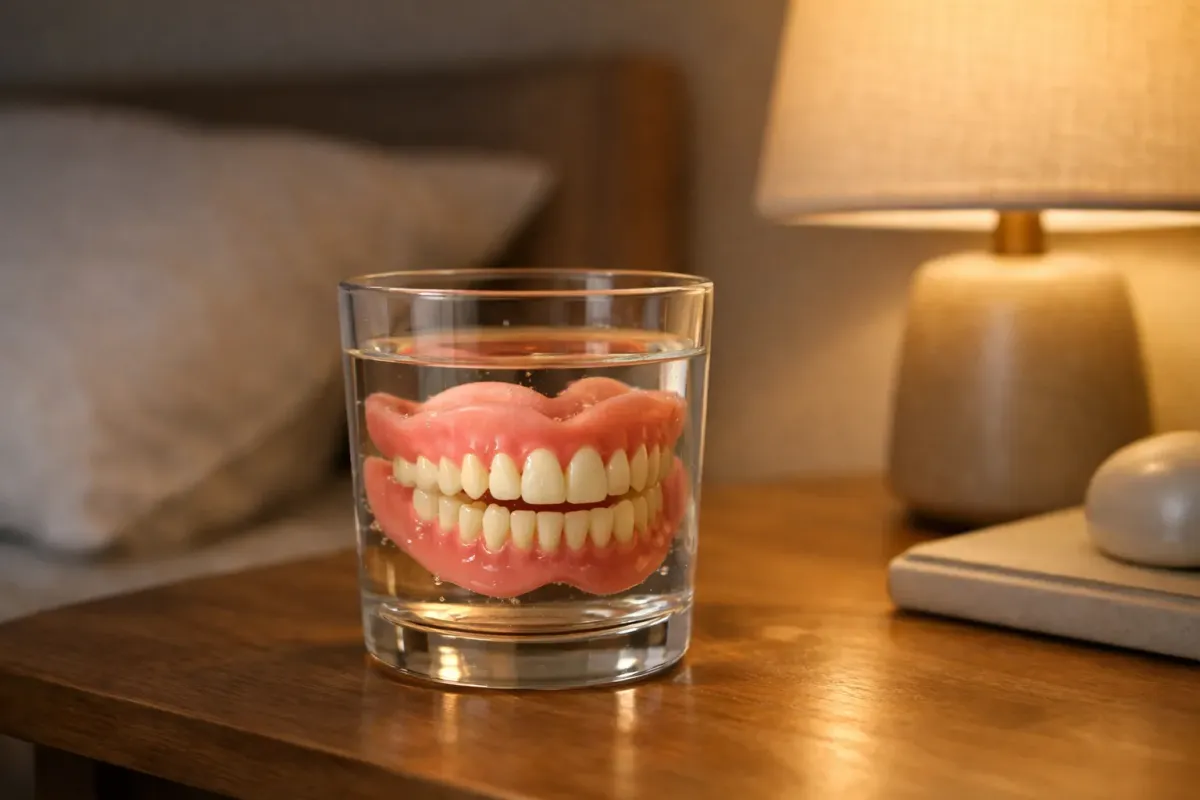
It depends on the kind of denture. With full removable dentures, you don't wear a night guard over them: the standard advice is to take the dentures out at night, which also takes away the hard surfaces you'd grind on. With a partial denture, a guard can often be made to fit your remaining natural teeth, usually with the partial out. With implant-supported teeth, a custom guard made over the prosthesis is common, because grinding is hard on implant parts.
Why dentures change the night guard question
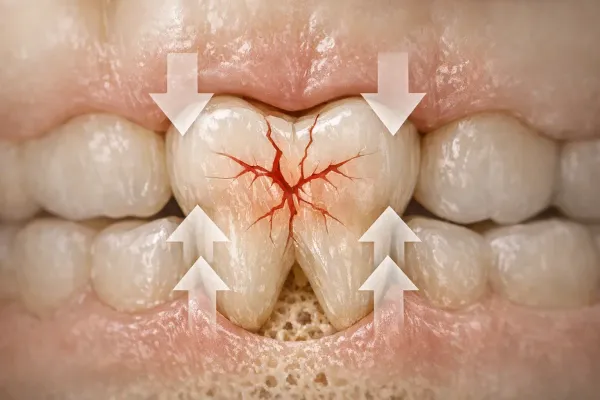
Losing your natural teeth does not switch off bruxism. Clenching and grinding are driven by the jaw muscles and the brain during sleep, not by the teeth themselves, so people keep doing it with dentures in, and some keep clenching their bare gums with dentures out.
A regular night guard works by covering natural teeth that are firmly anchored in bone. A removable denture is not anchored. It sits on your gums and is held by suction, clasps or attachments, so a guard stacked on top of it would just give the whole thing another way to rock around. That is why the answer splits three ways, depending on what is actually holding your teeth in.
Full dentures: take them out at night
If you wear a complete upper or lower denture, the usual advice from dentists is to remove it overnight and store it clean. Nobody makes a standard night guard to go over a full denture. The problem is less about grinding and more about what happens when a denture sits on your gums for 24 hours a day.
- Denture stomatitis. A 2023 review of denture stomatitis in the International Journal of Environmental Research and Public Health lists long-term denture wear and ill-fitting dentures among the causes of this Candida infection under the denture, and names avoiding nocturnal denture wear as part of standard management.
- Pneumonia risk in older adults. A 2015 study in the Journal of Dental Research followed 524 people aged 85 and older in Japan for three years. Denture wearers who slept in their dentures had about 2.3 times the risk of pneumonia compared with those who took them out, and they had more plaque, gum inflammation and Candida. It is an observational study in a very old group, so it shows an association, not proof. Still, it is a strong reason to take them out.
If you grind with dentures in (during the day, or because you nap in them), the damage shows up in the denture and your gums rather than your enamel. Acrylic teeth wear flat faster, and the extra pressure pushes the denture base into the gums, which is how you get sore spots. A denture that fits poorly moves more, which makes the sore spots worse. If your gums are consistently sore in the same places or your jaw aches in the morning, tell your dentist you think you clench. Adjusting the bite on the denture, a reline, or a new denture are the usual fixes, not a guard.
Partial dentures: a guard for the teeth you still have
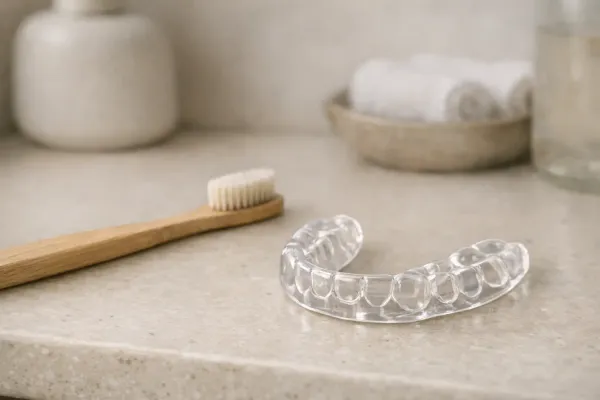
If you wear a removable partial, you still have natural teeth, and those teeth take the full force of grinding. A custom night guard can usually be made to cover them. In most cases the partial comes out at night and the guard goes in on its own, shaped to your remaining teeth and filling in over the gaps so your bite stays even.
Some people are told to wear the guard with the partial in, which needs a guard built around the partial's clasps. Which setup you get is your dentist's call, because it depends on how many teeth you have left, where the gaps are, and how stable the partial is. A few things to raise at the appointment:
- Tell the dentist you grind or clench, and ask whether the guard should be worn with the partial in or out.
- Bring the partial with you, so the impressions capture how it seats.
- If you get a new partial or have a tooth pulled later, bring the guard back for a fit check. A missing tooth changes the guard's fit just like it changes the partial's.
A boil-and-bite guard is a poor match here. It is designed for a full row of teeth, and molding one around gaps and clasps rarely gives an even bite. Our comparison of over-the-counter and custom guards covers why fit matters more than material. If you have a fixed bridge rather than a removable partial, the rules are different; see wearing a night guard with a dental bridge.
Implant-supported dentures and overdentures
This is where grinding matters most. Implants do not have the shock-absorbing ligament that natural teeth have, so heavy grinding force goes straight into the screws, abutments and prosthetic teeth. A 2025 systematic review and meta-analysis in the Journal of Prosthodontics pooled 13 studies and found bruxism was linked to higher odds of every mechanical complication it looked at, including screw loosening, prosthesis breakage, fractured ceramic and fractured implants.
What that means in practice depends on the type:
- Fixed implant bridges (the kind only your dentist can remove, such as "All-on-4" style). These behave like teeth. Dentists often make a hard acrylic guard over the fixed prosthesis to protect it at night.
- Removable overdentures that snap onto implants. Some people are told to take the overdenture out at night, others get a guard. A 2021 randomized trial in the Saudi Dental Journal of 42 bruxers with implant overdentures compared exactly those options: removing the overdenture at night, an occlusal guard, and Botox injections. The fact that researchers were still comparing them tells you there is no single settled answer.
Either way, this is a guard your implant dentist should design, since it has to fit the prosthesis rather than natural teeth. For more on why grinding and implants make a risky pair, see dental implants and bruxism.
Signs your guard or denture no longer fits
Dentures and the gums under them change over time, as the bone underneath slowly shrinks. That changes how a partial seats, and a guard made around your old setup can stop fitting too. Book a check if you notice:
- The guard rocks, or only seats with pressure.
- Sore spots on your gums in the same place each morning.
- Your bite on the guard feels uneven, or one side hits first.
- Clasps or teeth on a partial feel looser than they used to.
- Jaw or tooth soreness that starts after wearing the guard (our guide to tooth and jaw pain after a night guard helps sort out what's normal).
FAQs
Can you grind your teeth with dentures?
Yes. Bruxism comes from the jaw muscles and sleep, not the teeth, so it continues after tooth loss. With dentures in, it wears the acrylic teeth and presses the base into your gums, which causes sore spots.
Should I sleep with my dentures in to stop grinding?
Generally no. The standard advice is to take removable dentures out at night. Sleeping in them is linked to denture stomatitis, and a 2015 study found older adults who slept in dentures had a higher risk of pneumonia. Ask your dentist if you have a specific reason to keep them in.
Can you wear a mouth guard over dentures?
Not over full removable dentures. A guard stacked on a denture has nothing solid to grip and can make it shift. With a partial, the guard usually fits your natural teeth with the partial out. With a fixed implant bridge, a custom guard over the prosthesis is common.
Do I need a night guard with implant-supported dentures?
If you grind, ask about one. Research links bruxism to more screw loosening, fractures and other mechanical problems in implant prostheses. Your implant dentist can make a guard that fits over the fixed teeth, or advise removing an overdenture at night.
Can I use a boil-and-bite guard with a partial denture?
It is rarely a good fit. Boil-and-bite trays are made for a full row of teeth and don't mold well around gaps and clasps, so the bite ends up uneven. A dentist-made guard is the safer choice here.