Jaw Pain Treatment Grover MO: What Makes Local Care Different?
Explore jaw pain treatment in Grover, MO, from bruxism care to sleep evaluations, plus how to compare local providers and evidence-based options.

The clinical guideline “Management of chronic pain associated with temporomandibular disorders: a clinical practice guideline” supports starting with conservative care, including education and selected exercises, for many adults with persistent TMD pain. If you are researching jaw pain treatment in Grover, MO, that gives you a useful starting point: look for an assessment and a clear treatment goal, not an appliance sold as the answer to everything.
The meaningful local difference is access: who can evaluate you, where referrals lead, and whether follow-up fits your life. There is no established Grover-specific cause of jaw pain or evidence that a treatment works better simply because you receive it nearby.
Your best option depends on what is causing your symptoms. Tooth pain, jaw-muscle pain, joint problems, and sleep-related concerns can overlap, but they do not call for identical care.
Jaw Pain Treatment in Grover, MO: Start With the Cause, Not a Mouthguard
Jaw pain, TMD, and bruxism are not the same thing
Your temporomandibular joint, or TMJ, connects your lower jaw to your skull. You have one on each side. Temporomandibular disorders, or TMDs, affect those joints, your chewing muscles, or related structures. “TMJ” names the joint, not a complete diagnosis.
Bruxism is different. Awake bruxism can involve clenching or holding your jaw muscles tense while you are conscious, sometimes during concentration or stress. Sleep bruxism involves chewing-muscle activity during sleep, which may include grinding or clenching.
The expert report “International consensus on the assessment of bruxism: Report of a work in progress” distinguishes awake and sleep bruxism. It also explains that bruxism is not necessarily a disorder in otherwise healthy people. In plain language, the behavior matters most when it causes damage, pain, or other problems.
You can grind without having pain, and you can have jaw pain without grinding. Dental disease, headaches, and other conditions can also produce pain around your mouth and face. Your jaw deserves a diagnosis, not a shopping list.
What your symptoms can tell your care team
Morning soreness, tooth wear, headaches, locking, and pain with chewing provide clues. None is a diagnosis by itself. Worn teeth may reflect earlier grinding, acid erosion, or several factors together. Morning headaches do not prove that you grind or have sleep apnea.
A useful assessment starts with when symptoms began, where you hurt, and what triggers pain. Your clinician should ask whether your jaw catches or locks, as well as about injuries, dental work, medications, sleep, headaches, and habits such as gum chewing.
An examination may include your teeth, gums, jaw movement, and chewing muscles. A cracked tooth or dental infection needs a different plan from muscle-related pain.
The research-based framework “Diagnostic Criteria for Temporomandibular Disorders (DC/TMD) for Clinical and Research Applications” combines symptom history with a structured examination. It also considers how pain affects your daily life. That is more useful than diagnosing everyone with a clicking jaw the same way.
Imaging is selective, not an automatic admission ticket. Dental X-rays, CT, or MRI may be appropriate when the examination raises a specific question and the answer could change treatment.
When jaw pain needs urgent attention
Seek urgent assessment for fever with facial swelling, a significant facial or jaw injury, or a new inability to open or close your mouth. Do not try to force a locked jaw into position yourself.
Get emergency help for difficulty breathing or swallowing. Call 911 for jaw pain accompanied by chest pressure, shortness of breath, or other possible heart attack symptoms. Do not assume these symptoms are “just TMJ.”
Your Grover-Area Care Map: Which Provider Should You See?
Once urgent problems are ruled out, the next question is where to begin. Grover is in the wider Wildwood area of west St. Louis County. Your search may also extend to Ellisville, Chesterfield, or other parts of the St. Louis region.
A practice described as “serving Grover” is not necessarily located there. Confirm the street address before booking, especially if your plan could involve several adjustment or therapy visits.
Coordinated care is a reasonable goal, not proof of local superiority. What matters is whether your clinicians share useful findings and agree on who handles the next step.
Start with a dentist who evaluates jaw pain
A dentist can check for dental causes and assess your jaw symptoms. Ask whether the dentist routinely evaluates jaw pain, measures jaw movement, and checks for muscle tenderness. A general dentist may provide an appropriate first assessment.
That does not automatically make the dentist an orofacial pain specialist. Ask about relevant education, experience, and referral relationships rather than relying on a website label such as “TMJ expert.”
Confirm the treating clinician's name and check the license through the Missouri Division of Professional Registration. An active license establishes permission to practice, not advanced expertise in every advertised service.
When physical therapy or an orofacial pain referral makes sense
Physical therapy may help when an assessment identifies movement limitations, muscle-related pain, or relevant neck problems. Ask whether the therapist regularly treats TMD and how findings will be shared with your dentist.
The BMJ guideline on chronic TMD pain supports several exercise-based and hands-on approaches. That does not mean every exercise suits every jaw. Your program should match your symptoms, movement limits, and response to treatment.
Persistent pain, an uncertain diagnosis, repeated locking, or unsuccessful treatment may justify an orofacial pain referral. The American Academy of Orofacial Pain offers patient resources and specialist-finding information. Ask about formal training and whether your situation falls within the clinician's usual practice.
When you may need a sleep medicine specialist
Loud snoring, witnessed breathing pauses, and excessive daytime sleepiness warrant medical attention. Your primary care clinician can assess these symptoms and arrange a sleep referral when appropriate.
Jaw pain alone does not establish the need for a sleep study. Neither does tooth wear. A sleep evaluation should answer a specific medical question, not serve as an automatic add-on to every mouthguard consultation.
How to compare Grover and nearby options
Provider locations, staffing, services, and referral rules can change. Before choosing jaw pain treatment in Grover, MO, use these comparison routes to confirm what is actually available:
- Local dental route: Identify a dentist at a confirmed Grover or Wildwood-area address. Check the clinician's Missouri license, ask about jaw-pain assessment, and confirm whether you can book directly.
- Nearby physical therapy route: Ask your evaluating clinician for a therapist with TMD experience in a practical location. Confirm the therapist's license, relevant services, and any referral or insurance authorization requirements.
- Regional sleep medicine route: Consult an official health-system or sleep-center directory. Confirm the exact facility, clinician credentials, current services, and referral requirements. A health system offering sleep care does not mean every location provides it.
Compare appointment availability, repeated-visit travel, and communication between offices. A convenient first appointment is less useful if follow-up becomes a scheduling obstacle course.
Bruxism Treatment in Grover, MO: Compare Options Before You Commit
Searching for bruxism treatment in Grover, MO, can produce a long menu. Sort that menu by purpose: protecting teeth, managing pain, improving movement, or addressing contributing factors. One treatment does not necessarily accomplish all four.
Also ask whether your symptoms come from bruxism, TMD, another condition, or a combination. Research on chronic TMD pain does not automatically answer every question about sleep grinding.
Custom splints: tooth protection is not the same as a cure
A dental splint may help protect teeth from grinding-related damage without reliably stopping sleep bruxism. Reduced tooth damage, less pain, and reduced muscle activity are different outcomes. Ask which outcome your clinician expects and how it will be measured.
The Cochrane review “Occlusal splints for treating sleep bruxism (tooth grinding)” found insufficient evidence to establish that splints treat sleep bruxism effectively. It suggested that tooth protection may still be a benefit. The review is older, so it should not be presented as the final word on every current appliance.
For chronic TMD pain, the BMJ guideline conditionally recommends against reversible occlusal splints compared with placebo or sham treatment. That recommendation concerns pain management. It is not a blanket statement that no one needs protection for vulnerable teeth.
A custom appliance still needs a fit check and follow-up. Ask what to do if it causes discomfort, changes how your teeth meet, or seems to worsen symptoms. Bring an existing guard to your appointment rather than assuming you need another one.
A generic guard is not a substitute for finding the cause of pain. Buying something that fits over your teeth is easy. Determining whether it belongs in your treatment plan takes more work.
Daily habits and exercises tailored to your diagnosis
Education and small behavior changes can be part of conservative care. Your clinician may suggest avoiding prolonged gum chewing, noticing daytime clenching, or temporarily changing activities that clearly aggravate pain.
The goal is less unnecessary strain, not permanent fear of using your jaw. If softer foods help during a flare, ask when and how to return to your usual diet rather than staying on a restricted menu indefinitely.
Exercise should match your examination findings. Supervised jaw exercises, stretching, or posture-related exercises may be useful for some people with chronic TMD pain. Forceful stretching is not a universal remedy, especially if your jaw locks or movement causes sharp pain.
The BMJ guideline also supports cognitive behavioral therapy for chronic TMD pain. This approach can teach practical ways to manage pain-related habits, stress responses, and coping. It does not mean your pain is imaginary.
Botulinum toxin: questions about evidence, risks, and cost
Botulinum toxin injections are sometimes offered for jaw-muscle pain or bruxism. Treatment for bruxism is off-label in the United States. Off-label use does not automatically mean inappropriate care, but it does make a clear discussion of evidence and alternatives important.
The BMJ guideline conditionally recommends against botulinum toxin injections for chronic TMD pain. This reflects the balance of available evidence, possible harms, and other treatment choices. It does not establish the best plan for every individual or every reason for grinding.
Discuss chewing weakness, facial asymmetry, injection-related problems, swallowing difficulties, and uncertainty about repeated long-term treatment. Ask how long the intended effect may last, what repeat visits cost, and what happens if treatment does not help.
When appropriate, begin with reversible options. Permanent tooth grinding, major bite changes, or surgery should not be routine shortcuts for an unclear diagnosis. National Institute of Dental and Craniofacial Research guidance also cautions against treatments that permanently change your teeth, bite, or jaw joints without a sound reason.
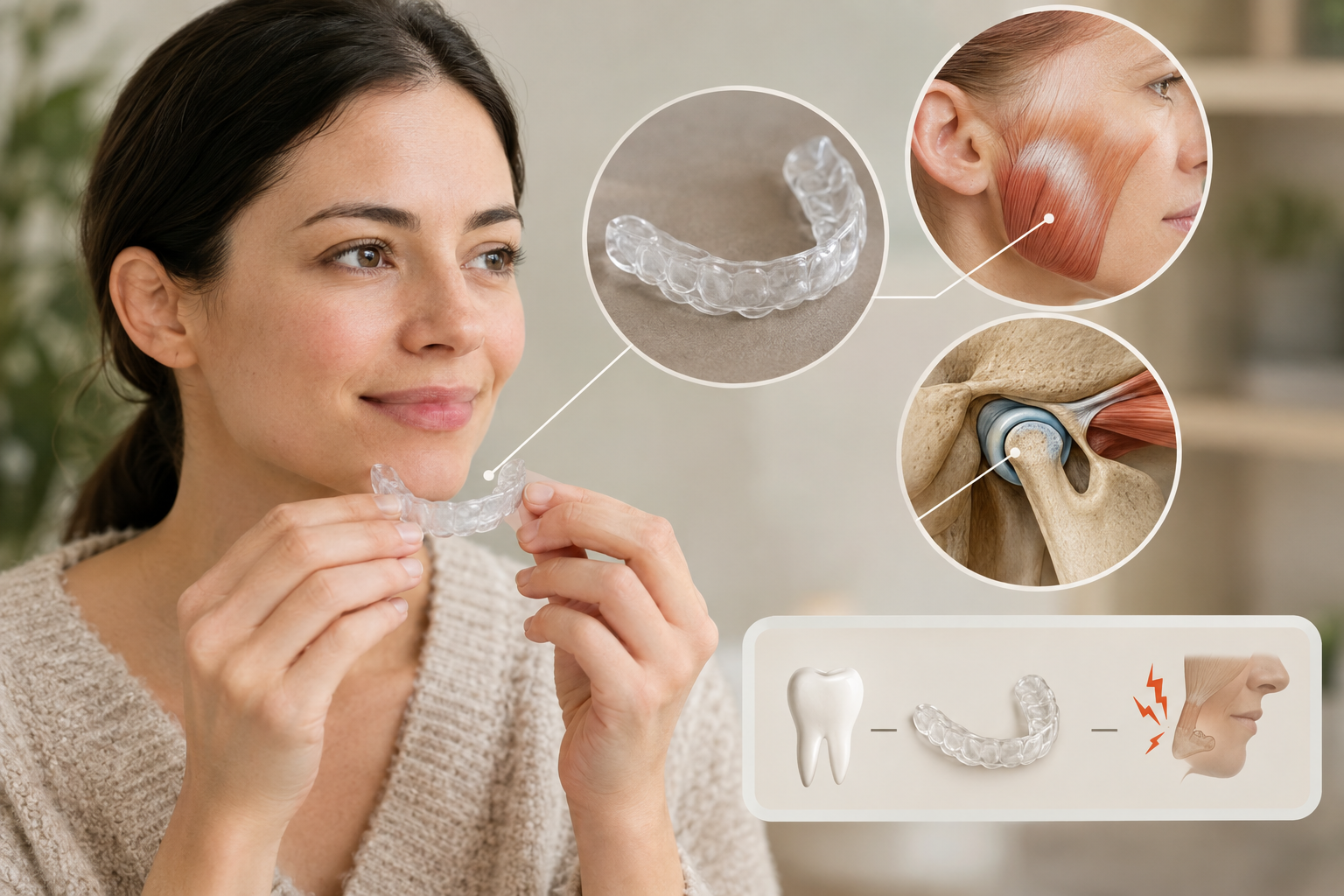
When Jaw Pain Overlaps With Poor Sleep or Migraine
Grinding, headaches, and restless sleep can occur together. That makes a shared discussion worthwhile, but it does not establish one shared cause. You may need more than one diagnosis and more than one treatment goal.
This distinction matters when comparing local jaw pain treatment. A practice offering several services should still explain which problem each service is intended to address.
Why snoring and daytime sleepiness deserve a separate evaluation
Tell your medical clinician about loud snoring, witnessed breathing pauses, morning headaches, and daytime sleepiness. Include observations from someone who has seen you sleep, if available.
If you are struggling to stay awake while driving, avoid driving and seek prompt medical advice. That is a safety concern, not something to put on hold until your next dental cleaning.
A bruxism guard and an oral appliance prescribed for obstructive sleep apnea serve different purposes. The first generally aims to manage grinding-related effects, including tooth damage. The second helps maintain an open airway in selected patients.
The guideline “Clinical Practice Guideline for the Treatment of Obstructive Sleep Apnea and Snoring with Oral Appliance Therapy: An Update for 2015” describes a shared role for sleep physicians and qualified dentists. When oral appliance therapy is prescribed for sleep apnea, it recommends a custom, adjustable device rather than a noncustom device, along with follow-up care and sleep testing to assess effectiveness.
In plain language, a sleep apnea appliance is not just a more expensive nightguard. It belongs in a medical treatment plan with a way to check whether it works.
Neither tooth wear nor a jaw examination diagnoses sleep apnea. Sleep testing follows a clinical evaluation, not an assumption that everyone who grinds has a breathing disorder.
How migraine can complicate jaw-pain care
Migraine and TMD can coexist. Treating one does not necessarily cure the other, and not every headache near your temples starts in your jaw muscles.
Tell your clinician whether headaches involve nausea, light sensitivity, worsening with activity, or a recurring pattern. Also describe whether chewing reliably triggers or worsens your familiar pain.
These details help your care team decide whether you need dental assessment, headache evaluation, or both. They do not replace a clinical diagnosis. If headaches change suddenly or come with concerning symptoms, seek medical assessment rather than assuming an existing jaw problem explains them.
What coordinated local referrals should accomplish
Your dentist can share examination findings with your primary care clinician. Your primary care clinician can assess broader medical concerns and arrange sleep or headache evaluation when indicated.
A sleep specialist or headache clinician should know what appliance or pain treatment you already use. Likewise, your dentist should know if another clinician changes your treatment in a way that affects sleep, alertness, or jaw symptoms.
Bring your medication list, previous appliance information, sleep observations, and a headache diary. Ask who will explain results and who is responsible for the next step. A referral should move useful information, not just your name and insurance number.

How to Compare Local Jaw Pain Treatment Without Buying the Hype
Comparing local jaw pain options gets easier when you compare explanations and follow-up plans, not just devices. A useful consultation connects your symptoms, examination findings, proposed treatment, and reassessment schedule.
The DC/TMD framework considers both physical findings and the effects of pain on daily life. That is a practical meaning of whole-person care: a broad, individualized assessment. “Holistic” is not a scientific stamp of approval for every product sold under that label.
Questions to ask at your first appointment
Ask what the clinician thinks is happening and how certain that explanation is. A working diagnosis can change as new information appears. That is different from recommending expensive treatment without explaining the diagnosis at all.
Bring this appointment checklist:
- What is your working diagnosis, and what findings support it?
- What else could explain my symptoms?
- Is treatment needed now, and what happens if I wait?
- What is treatment intended to change: pain, tooth damage, movement, or something else?
- What evidence supports this option for someone with my diagnosis?
- What are the alternatives, including watchful waiting when appropriate?
- What risks or side effects should I watch for?
- What training and experience do you have with this problem?
- When will we reassess, and what would make us change the plan?
- Who coordinates referrals if symptoms persist?
Be cautious about permanent-cure promises, pressure to commit immediately, or irreversible procedures proposed before a clear evaluation. You should be able to explain the treatment goal in your own words before agreeing to it.
A second opinion is reasonable when a recommendation is costly, invasive, or difficult to reverse. Ask for copies of relevant records so the next clinician can review what has already been done.
Costs, insurance, and follow-up logistics
Request a written plan and an itemized estimate. For an appliance, ask whether the price includes fitting, adjustments, follow-up visits, repairs, and replacement.
For injections or therapy, ask about the expected visit schedule and how the plan changes if you do not improve. Clarify whether additional imaging, specialist consultations, or testing could create separate charges.
Dental and medical insurance may cover different services under different rules. Confirm benefits, network participation, referral requirements, and prior authorization directly with your plan. An office accepting your insurance does not guarantee reimbursement for a particular service.
Think beyond the first appointment. Repeated trips across the region may affect whether a reasonable plan is workable. Ask about actual scheduling rather than assuming a nearby office has short waits.
How you and your clinician can track progress
Record pain, chewing ability, locking episodes, headache days, and daytime function before treatment and at agreed intervals. A simple weekly note is often more useful than trying to remember three months at once.
Keep the measures tied to your goal. If you are treating pain, track pain and function. If an appliance is intended to protect teeth, ask how your dentist will monitor wear, damage, and fit. Fewer grinding sounds do not answer every question.
Improvement means more than a quieter jaw. Easier meals, fewer painful mornings, and better daily function matter. Painless clicking alone does not automatically require treatment.
Agree on what success looks like before adding another intervention. If progress stalls, revisit the diagnosis, treatment fit, and follow-up plan rather than automatically buying the next device.
Your Next Step Toward Better Jaw Care in Grover
The useful local difference is a verified, convenient care pathway that matches your diagnosis. It is not a special Grover-only remedy. A nearby clinician who explains the findings, offers appropriate conservative options, and communicates with other professionals can make care easier to navigate without promising a cure.
Take three practical steps:
- Document your symptoms. Note when pain occurs, what affects chewing, whether locking happens, and any sleep or headache concerns. Bring information about past treatment and current appliances.
- Choose a clinician who explains the diagnosis. Confirm the office location, relevant credentials, treatment goals, costs, and follow-up arrangements before committing.
- Request coordinated referrals when needed. Snoring, daytime sleepiness, recurring headaches, or persistent pain may deserve attention beyond the dental chair.
Bruxism, TMD, migraine, and sleep apnea are distinct conditions that can overlap. You do not need to sort them out alone, and you do not need to purchase every treatment at the first visit.
When you are ready to pursue jaw pain treatment in Grover, MO, verify a provider's location and qualifications, schedule an evaluation, and bring your checklist. Start with a clear plan, not the fanciest gadget.