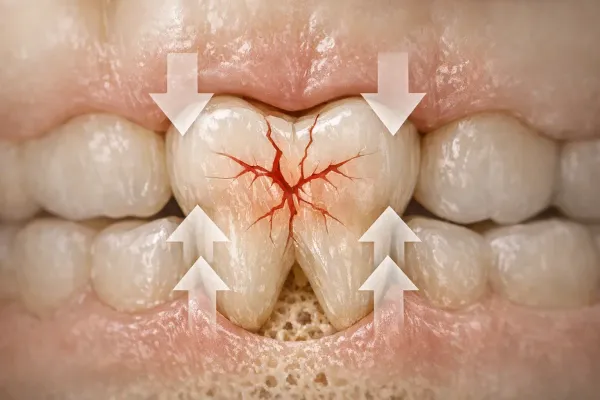
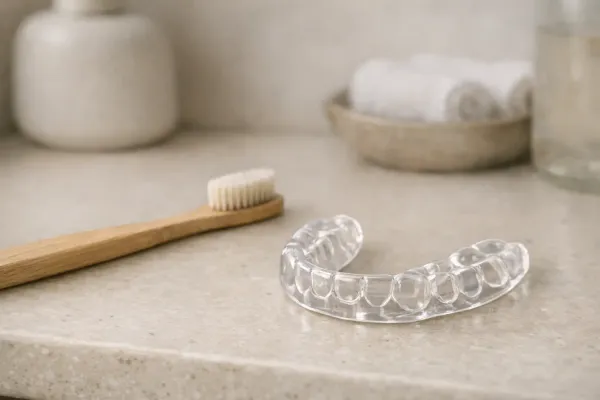
Night Guard and Retainer: Can You Wear Both?
You can't stack a night guard on a clear retainer, and grinding wears thin retainers out fast. Here are the setups that work: a guard that doubles as a retainer, a bonded wire plus a guard, or a thicker combined appliance.
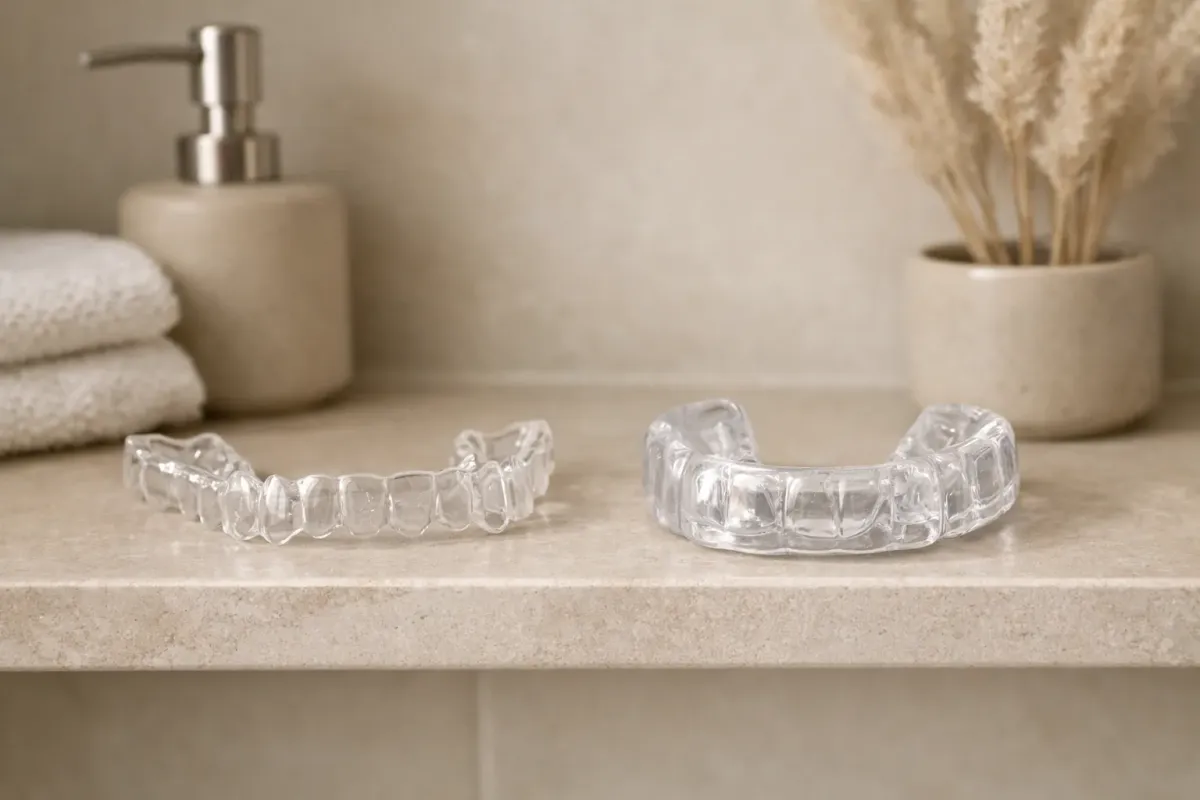
You can't wear a night guard and a clear retainer at the same time, because both are shaped to snap over the same teeth and neither will seat properly on top of the other. What you can do is pick one appliance that does both jobs at night, or pair a bonded wire retainer with a guard that fits over it. Your orthodontist should make that call, since they know how much your teeth want to drift back.
Why you can't just stack them
A clear retainer and a night guard do different jobs. The retainer holds your teeth where the orthodontist put them. The guard takes the beating when you grind, so your enamel doesn't. Both are molded to the exact shape of your teeth, so stacking one over the other means neither fits: the guard rocks, the retainer gets squeezed, and your bite ends up propped open by two layers of plastic.
The bigger problem is that a thin clear retainer was never built to be a grinding surface. Clear retainers (often called Essix or vacuum-formed retainers) are a sheet of thermoplastic heated and sucked down over a model of your teeth. That's fine for holding position. It is not great for absorbing hours of clenching every night.
What grinding does to a clear retainer
Clear retainers are the most fragile of the common types, before grinding even enters the picture. A 2018 survival analysis of 591 retainers in the European Journal of Orthodontics found the 34 vacuum-formed retainers in the sample had a median survival of 105 days before needing repair or replacement, compared with 1,604 days for bonded lingual wires and 1,529 days for Hawley (wire and acrylic) retainers. Fracture was the most common reason the clear ones failed.
The material also matters. A 2024 lab study in Clinical Oral Investigations tested four Essix-type retainer materials on a wear machine and found real differences in how much surface wore away and how stiff each one was. The authors specifically said material choice should account for patient factors, including parafunctional habits, which is dentist-speak for grinding and clenching. That study was done on a machine, not in people, so it tells you materials differ, not exactly how fast yours will wear.
Signs your retainer is losing the fight with your jaw:
- Shiny flat spots or holes worn through over the back teeth
- Cracks, usually near the edges or between teeth
- It clicks in loosely or doesn't grip like it used to
- Your teeth feel tight when you put it back in after a night off, which means they are starting to shift
A retainer with a hole in it is still sort of holding your teeth. It is no longer protecting them.
Your options if you grind and wear a retainer
There's no single right answer here, and the research on combining the two is thin. These are the setups orthodontists commonly use:
- A full-coverage hard guard that doubles as your night retainer. A well-fitted hard acrylic guard covers every tooth in the arch, so it tends to hold them in place while you sleep. A guard covers only one arch, so the other arch still needs its own retainer. Many people end up wearing the guard at night and a clear retainer (or nothing) during the day. Your orthodontist has to agree the guard fits tightly enough to do retainer duty.
- A thicker combination appliance. Some orthodontists will make a retainer from a thicker, harder material, or design a guard for the opposite arch, so one appliance takes the grinding load.
- A bonded wire retainer plus a night guard. A thin wire glued behind your front teeth holds them 24 hours a day, and a guard can be made to fit over it. The catch: the wire is held on with dental bonding, and heavy grinding puts that bond under extra stress. Get the wire checked at every visit.
- Alternating: retainer during the day, guard at night. This only works if your orthodontist says your teeth are stable enough, and it's usually more likely later in retention than in the first months after braces come off.
If your orthodontist is happy for a custom guard to take over nighttime duty, the guard needs to be taken from impressions of your teeth as they are now, after treatment. An old guard from before braces will not fit.
If you need a guard that fits your new smile
A custom guard for your post-orthodontic teeth costs less than most people assume. Pro Teeth Guard is a dental lab that has supplied dental offices for over 20 years and sells the same custom guards direct, at roughly $145 to $220. Their guards are lab-pressed acrylic rather than the soft thermoplastic in a boil-and-bite tray.
Home impression kit, 7 to 11 business days to build, free adjustments if the fit is off, and a 60-day 110% money-back guarantee. Take the impression once your orthodontic treatment is finished, and check with your orthodontist before you use any guard in place of your retainer.
Check current Pro Teeth Guard pricing
Affiliate link. If you buy through it we earn a commission, at no extra cost to you. How this works.
Don't drop the retainer to make room for the guard
The tempting shortcut is to stop wearing the retainer and just wear the guard. That can work if the guard is doing the retaining, but skipping retention altogether is how people end up paying for braces twice. The 2023 Cochrane review of orthodontic retention puts it plainly: without a retention phase, teeth tend to relapse back toward where they started. The same review found the evidence comparing retainer types is low to very low certainty, which is one more reason the choice belongs with the person who moved your teeth.
Ask your orthodontist, not only your general dentist. Your dentist can make a great night guard, but the orthodontist knows which teeth were the hardest to move and most likely to wander. If you went through clear aligners, the same logic applies; our post on wearing a night guard with Invisalign covers the in-treatment version of this problem.
FAQs
Can a retainer work as a night guard for teeth grinding?
Not well. A thin clear retainer will cover your teeth, but grinding tends to crack it or wear through it, and then it protects nothing. If you grind, ask your orthodontist about a thicker appliance or a separate guard.
Can I wear my retainer during the day and my night guard at night?
Often, yes, but only if your orthodontist agrees your teeth are stable enough for part-time retainer wear, or confirms your guard fits tightly enough to hold them overnight. Don't set that schedule on your own in the first months after braces.
Does wearing a retainer make you grind your teeth?
Probably not, at least in the short term. A 2018 trial in Progress in Orthodontics measured jaw muscle activity during sleep in 19 healthy people and found no significant difference between nights with and without clear retainers. Visible wear on a retainer can be a sign of grinding, so it is worth mentioning to your dentist or orthodontist.
Do plastic retainers shed microplastics?
A 2025 review in Dentistry Journal found retainer materials are generally biocompatible, with bisphenol-type release reported below regulatory limits, though long-term data are limited. It flagged single-use thermoplastics as a microplastic and waste concern. We cover the guard side of this in do you swallow microplastics from your night guard. How much a retainer sheds when it is ground down every night has not been well measured.
Can I wear a night guard with a permanent (bonded) retainer?
Yes. The guard is made from an impression taken with the wire in place, so it fits over it. Get the wire checked regularly, because grinding puts extra stress on the bond.
How often should I replace a retainer if I grind?
Whenever it cracks, wears through, or stops gripping. For grinders that can be much sooner than for everyone else. For the guard side, see how long a night guard lasts.