How Sleep Positions Influence Nighttime Teeth Grinding
Your Sleep Position Matters More Than You Think
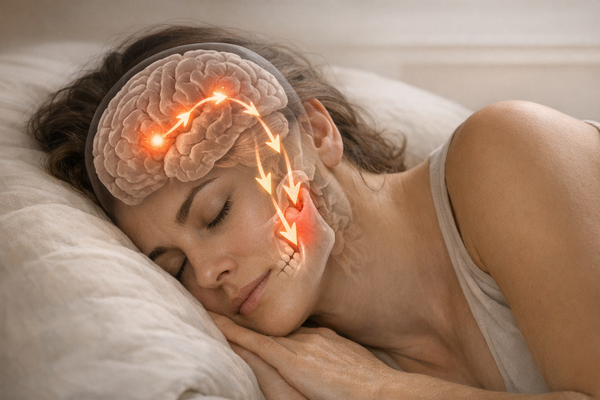
If you grind your teeth at night, you've probably focused on the usual suspects: stress, genetics, an imperfect bite. But there's a variable you might be overlooking, one that shapes your jaw mechanics for roughly eight hours every night. Your sleep position directly influences how your jaw sits, how much pressure builds along the temporomandibular joint, and how likely you are to clench or grind while you sleep.
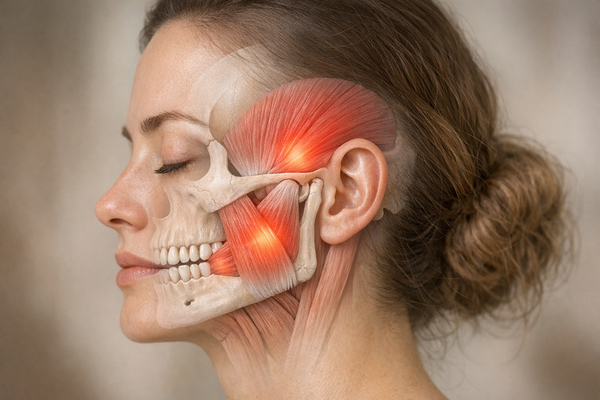
The research on bruxism and sleep position is still emerging, but the findings so far are consistent enough to act on. A 2023 study in the Journal of Oral Rehabilitation found that body posture during sleep significantly affected EMG (electromyography) activity in the masseter muscles, the primary muscles responsible for clenching. In other words, change the position, change the grind.
Understanding what causes teeth grinding is the first step. This article is about the second step: figuring out whether the way you sleep is making it worse, and what you can do about it.
How Sleep Position Changes Jaw Alignment
To understand why position matters, think about gravity. When you're upright, your lower jaw (the mandible) hangs naturally, with a small gap between your upper and lower teeth. Dentists call this the "freeway space" or rest position. Your teeth aren't supposed to touch when your jaw is relaxed.
When you lie down, gravity's relationship with your jaw changes entirely. Depending on which way you're facing and how your head is supported, the mandible can shift forward, backward, or laterally. Each of those shifts alters the contact pattern between your teeth and the tension in the muscles that control your jaw.
Research from Hokkaido University published in Sleep and Breathing (2019) measured jaw displacement across different sleep postures using motion-capture technology. The team found that lateral (side) and prone (stomach) positions created measurable asymmetry in mandibular position compared to supine (back) sleeping. That asymmetry correlates with uneven muscle activation, which is essentially the precondition for grinding.
Each Sleep Position, Analyzed
Back Sleeping (Supine)
Sleeping on your back is generally considered the most neutral position for your jaw. Gravity pulls the mandible straight down, maintaining symmetry. There's no external pressure on either side of the face, and the TMJ sits in a relatively natural alignment.
A 2020 study in Cranio: The Journal of Craniomandibular Practice found that supine sleepers showed lower average EMG activity in the masseter and temporalis muscles compared to side and stomach sleepers. The researchers noted that the symmetrical gravitational load on the mandible likely reduced involuntary muscle activation.
The catch: back sleeping isn't perfect for everyone. If you have obstructive sleep apnea (OSA), sleeping supine can worsen airway collapse, which itself is a known trigger for bruxism. The brain sometimes activates jaw clenching as a reflex to reopen a narrowed airway. So for people with untreated sleep apnea, the "best" jaw position might come with the worst breathing dynamics.
Verdict: Best for jaw symmetry and muscle relaxation. Potentially problematic if you also have sleep-disordered breathing.
Side Sleeping (Lateral)
Side sleeping is the most common position, used by roughly 60% of adults. For bruxism, it's a mixed bag.
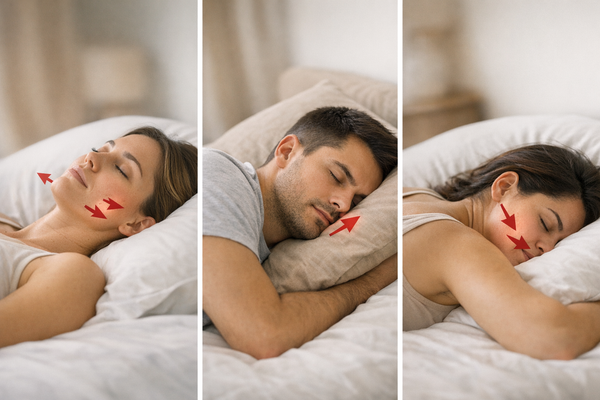
On the positive side, lateral sleeping keeps the airway more open than back sleeping, which can reduce apnea-related clenching. On the negative side, the weight of your head pressing against the pillow pushes the mandible toward the opposite side. This lateral displacement creates asymmetric loading on the TMJ and uneven muscle tension.
If you consistently sleep on the same side, this gets worse over time. Chronic one-sided sleepers often develop more pronounced TMJ symptoms on the side they sleep on, including clicking, soreness, and limited range of motion. A study in the Journal of Prosthodontic Research (2021) found a statistically significant association between habitual sleeping side and the side of dominant TMJ dysfunction.
There's also the pillow variable. A pillow that's too high pushes the jaw laterally. A pillow that's too flat lets the head drop, compressing the lower TMJ. Getting the height right is critical for side sleepers (more on this below).
Verdict: Better than stomach sleeping, worse than back sleeping for bruxism. If you side-sleep, alternate sides and get your pillow height dialed in.
Stomach Sleeping (Prone)
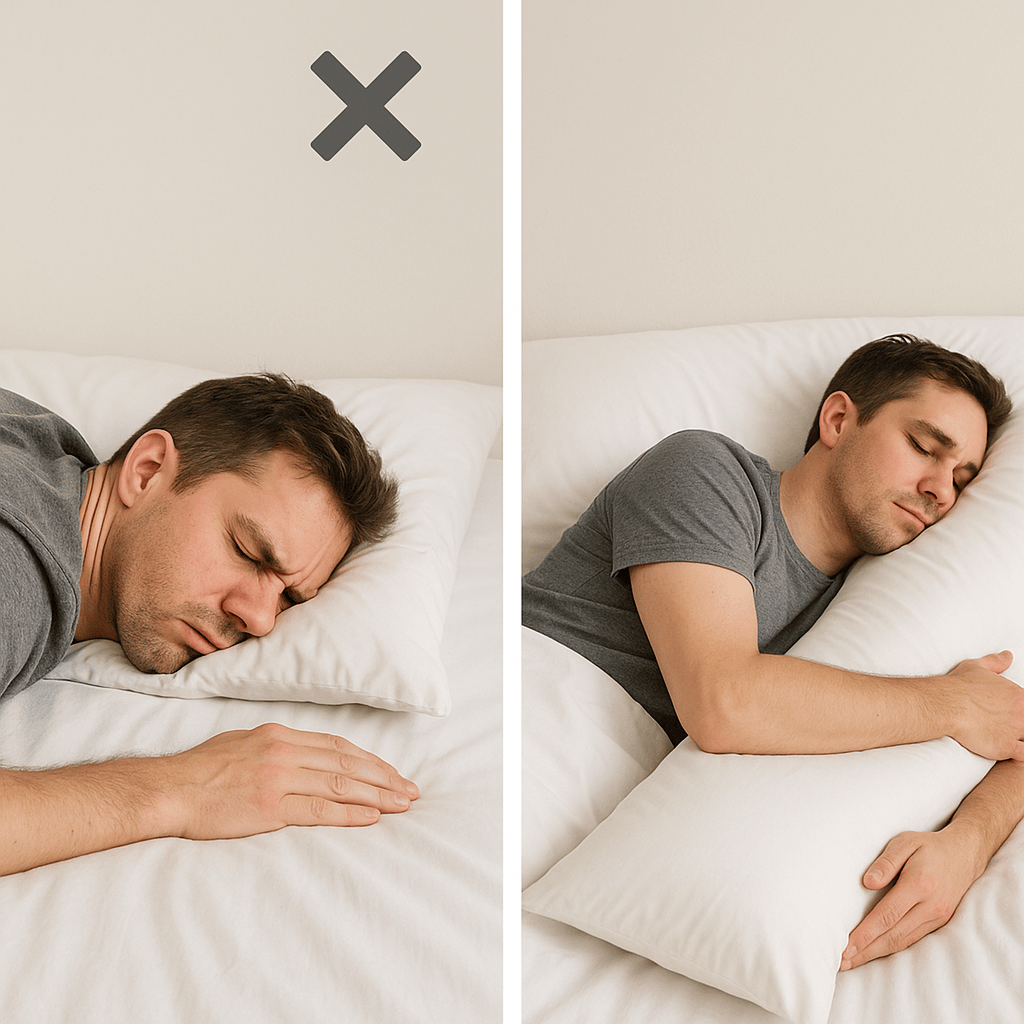
This is the worst position for bruxism, and it's not particularly close. Stomach sleeping forces you to turn your head to one side to breathe, which rotates the cervical spine and pushes the mandible into a distorted position. The jaw is pressed directly against the pillow or mattress, creating constant lateral and compressive force on the TMJ.
A polysomnographic study published in Sleep Medicine (2018) recorded significantly higher rhythmic masticatory muscle activity (RMMA), the hallmark EMG pattern of sleep bruxism, in participants who spent time in the prone position compared to supine. The researchers hypothesized that the cervical rotation required for breathing in this position activates the trigeminal nerve pathways that trigger jaw clenching.
Beyond bruxism, stomach sleeping is associated with neck pain, lower back strain, and facial pressure that can worsen TMJ inflammation. If you already experience jaw pain from wearing a night guard, stomach sleeping compounds the problem by adding external pressure on top of the guard's internal forces.
Verdict: Avoid if you grind your teeth. The jaw mechanics are poor, the cervical rotation triggers muscle activity, and the face-down pressure aggravates the TMJ.
Fetal Position
The fetal position is essentially an extreme version of side sleeping, with the added complication of a curled spine and forward head posture. When your chin tucks toward your chest, the mandible gets pushed posteriorly (backward), compressing the posterior aspect of the TMJ disc.
This posterior compression is particularly problematic for people who already have TMJ disc displacement, one of the more common TMJ disorders. The curled posture also rounds the upper back and shortens the muscles along the front of the neck, which increases baseline tension in the suprahyoid muscles that connect to the jaw.
Verdict: Similar concerns to side sleeping, with added cervical and postural complications. If you naturally curl up, try to keep your body more extended and your head neutral rather than tucked.
Pillow Height and Jaw Tension
Your pillow is the interface between your sleep position and your jaw. Get it wrong, and even a good sleep position becomes a bad one.
The goal is cervical neutrality: your spine from your lower back through your neck should maintain its natural curve, with your head neither tilted up, down, nor to either side. When the cervical spine is neutral, the muscles that support the jaw are at their resting length, which minimizes involuntary clenching.
Here's what the research suggests for pillow selection based on sleep position:
- Back sleepers: A medium-loft pillow that supports the natural cervical curve without pushing the head forward. Memory foam contour pillows work well here. The chin should not be pushed toward the chest.
- Side sleepers: A higher-loft pillow that fills the gap between the shoulder and the ear. The head should remain level, not tilted toward or away from the mattress. This is where most people get it wrong, using a pillow that's too flat and letting the head drop.
- Stomach sleepers: A very thin pillow or no pillow at all, though the better advice is to stop stomach sleeping entirely.
A 2022 randomized controlled trial in Physiotherapy Theory and Practice found that participants who switched to ergonomically fitted pillows showed a 23% reduction in self-reported morning jaw pain and headache frequency over eight weeks. The study didn't isolate bruxism specifically, but reduced jaw pain suggests reduced overnight clenching forces.
Sleep Position and TMJ Symptoms
Bruxism and TMJ disorders overlap significantly, and sleep position affects both. If you already have TMJ dysfunction, your sleep position can either give the joint time to recover or subject it to hours of sustained mechanical stress.
The TMJ is a synovial joint with a fibrocartilage disc that acts as a cushion between the condyle (the ball) and the fossa (the socket). When you sleep on your side or stomach, external pressure on the face can push the condyle into the disc in ways that don't occur during the day. Over time, this contributes to disc displacement, capsule inflammation, and the kind of morning stiffness and pain that makes you dread the first yawn of the day.
If you're using a mouth guard for TMJ relief, pairing it with a better sleep position amplifies the benefit. The guard redistributes bite forces, and the position minimizes external mechanical stress. Together, they give the joint the best chance to rest and recover overnight.
Practical Tips for Changing Your Sleep Position
Telling someone to "just sleep on your back" is about as useful as telling someone to "just relax." Sleep position is deeply habitual, and you can't consciously control it once you're asleep. But you can create conditions that make your preferred position more likely.
- Use a positioning pillow. Body pillows, wedge pillows, or specialized sleep positioners can make it physically difficult to roll onto your stomach. For side-to-back transitions, placing a pillow under your knees makes back sleeping more comfortable and sustainable.
- The tennis ball method. Sew a tennis ball into the front of your sleep shirt to discourage stomach sleeping, or into the back if you're trying to stay on your side (for apnea-related reasons). It sounds crude, but several sleep studies have validated this technique for positional therapy.
- Gradual transition. Start each night in the target position and fall asleep that way. You'll likely shift during the night, but over weeks, the amount of time spent in the target position tends to increase. Sleep tracking apps or devices can help you monitor progress.
- Address comfort barriers. People avoid back sleeping because it's uncomfortable, often due to lower back pain. A pillow under the knees and a supportive mattress can eliminate most of that discomfort.
- Give it time. Research on positional therapy for sleep apnea suggests it takes 4 to 6 weeks to see consistent position changes. The same timeline likely applies to bruxism-related position training.
Other Sleep Factors That Affect Grinding
Sleep position doesn't operate in isolation. Several other sleep-related variables interact with position to determine your bruxism risk on any given night.
Sleep Stage
Most sleep bruxism episodes occur during lighter sleep stages (N1 and N2) and during transitions between sleep stages, not during deep sleep or REM. These episodes are closely linked to "micro-arousals," brief spikes in brain and cardiac activity that occur naturally throughout the night. Anything that increases micro-arousals (caffeine, noise, an uncomfortable sleep position) increases bruxism episodes.
Sleep Apnea Connection
The relationship between obstructive sleep apnea and bruxism is one of the more compelling findings in recent sleep research. Studies estimate that 25% to 50% of people with OSA also have sleep bruxism. The leading theory is that bruxism serves as an airway-protective reflex: when the airway narrows, the brain triggers jaw clenching to push the mandible forward and reopen it.
This matters for sleep position because the supine position worsens OSA. If your bruxism is driven by airway issues, sleeping on your back might reduce direct jaw strain while increasing the apnea events that trigger grinding. In that scenario, side sleeping with proper pillow support is likely the better compromise.
Alcohol and Bruxism
Alcohol disrupts sleep architecture, increasing time in lighter sleep stages and boosting micro-arousal frequency. Multiple studies have found that alcohol consumption significantly increases bruxism activity, with the effect being dose-dependent. Even moderate drinking (two drinks) within a few hours of bedtime measurably increases RMMA episodes. Combine alcohol with a bad sleep position and you're stacking the odds against your jaw.
Night Guards and Sleep Quality
A well-fitted night guard can reduce the damage from grinding regardless of your sleep position. Some research suggests that occlusal splints may also reduce the frequency of bruxism episodes, though the evidence is less consistent. If you're curious about the tradeoffs, there's a detailed look at whether night guards affect sleep quality that covers the research.
The Bottom Line
The best sleep position for bruxism is on your back, with a pillow that keeps your cervical spine neutral and your jaw symmetrically aligned. Side sleeping is a reasonable second choice, especially if sleep apnea is part of the picture, provided you use a pillow with enough loft to keep your head level. Stomach sleeping and the tight fetal position are the worst options for both bruxism and TMJ health.
Changing your sleep position won't cure bruxism on its own. But combined with a good night guard, reduced alcohol intake, and treatment for any underlying sleep-disordered breathing, it's one more lever you can pull. Given that you spend a third of your life asleep, it's a lever worth pulling.